
Uncategorized

Featured image
Uncategorized

LinkedIn Profile Optimization Tips for 2026

By 2026, LinkedIn will be the most popular professional networking platform with more than 1 billion users around the world, and pro-optimizing the profile will become one of the most important factors in advancing a career. It may be active job-seeking, advancing your personal brand, or growing your own network; a properly optimized profile on LinkedIn can lead you to the opportunity of a lifetime. This is a step-by-step plan and tactics that can be applied to change your LinkedIn existence and make yourself recognizable in an ever competitive online world. Understanding LinkedIn’s 2026 Algorithm The algorithm at LinkedIn has developed and now focuses more on authentic interactions and content instead of on vanity. The platform is now applied to pair professionals with opportunities with the help of sophisticated AI; therefore, strategic optimization is the key to visibility. Learning about the algorithm will make you create a profile that will be found in recruiter search results and suggested contacts. The algorithm takes the completeness of profiles, engagement levels, quality of content, and connections strength in deciding the profile to display. Being an engaged LinkedIn member with frequent activity, meaningful interactions, and regular updates is an indication to LinkedIn that you are an active professional, worthy of being promoted to other people in your network and industry. Crafting a Compelling Professional Headline Your headline is the prime real estate, which will be displayed in search results, connection requests, and comments that you leave throughout the platform. The best headlines in 2026 will not only include job titles in job advert but will convey value propositions and expertise as well. Rather than just describing it as a Marketing Manager, write Marketing Manager| Grow 200 ROI by working with Data-Driven Digital Campaigns| B2B SaaS Specialist. Use the appropriate keywords that recruiters and other prospective clients may utilize, but ensure authenticity and readability. Through your headline, you need to be able to convey instantly who you are, what you do, and what makes you offer organizations or clients unlike anyone else. Imagine it as your career slogan that will give people the desire to know more about you. Optimizing Your About Section for Maximum Impact The about section gives you 2,600 characters to present your professional story in an appealing manner. Begin with a powerful introduction that catches the attention of readers right away, solving their possible need or making an effective statement on what your professional mission is all about. The first two lines should be used strategically since they appear before the see more button in the mobile gadgets. Divide your About section into important paragraphs and think about the use of bullet points to support the most important accomplishments, experiences, or services. Use first person to establish unity and reality. Use the keywords as a part and parcel of the text rather than including them in the text to enhance its readability and look less robotic. Discuss your career path, including turning points, career breakthroughs, and motivation behind your career. Include a definite call-to-action with an invitation to connect, make an appointment, or discuss the possibility of cooperation. This section ought to show your personality, yet in a manner that is professional in your industry. Leveraging AI-Enhanced Profile Features The capabilities of the AI features in LinkedIn will enable unmatched capabilities in personalization and optimization in 2026. The platform is now able to offer AI-based recommendations on improving your profile, content ideas and connection options, depending on your objectives. Seize the opportunities of these tips and keep your own voice and professional image. The AI writing assistant of LinkedIn can make your profile sections better, although you should always check and edit the recommendations to reflect your experience and professional level. The AI will be able to detect the weak areas of your profile, give appropriate skills to include, and provide content topics that appeal to your target community. Strategic Skills Endorsement Management Skills endorsements have been advanced and nowadays the algorithm used by LinkedIn takes into consideration credibility of people who have made the endorsements and the applicability of skills to your actual work. Increase the priority of your three best skills as they will gain the most visibility and weight assigned by the algorithm. Periodically revisit and rearrange your list of skills so that the most pertinent skills are listed at the top. Proactively use recommendations by colleagues, clients, and supervisors who can have the professional standing to recommend particular competencies. Return the favor, only promote those people when you have seen them perform that skill. The endorsements of reputed persons in your industry are worth much more than a multitude of endorsements of remote acquaintances. Recommendations That Actually Matter In 2026, LinkedIn recommendations can be viewed as effective social proof that can affect the decision of the recruiter and their clients. Ask strategic managers, clients, as well as colleagues to make recommendations on the basis of which they can discuss your contribution and character. Relate when asking advice, reminding the individual of any particular projects or accomplishments they saw. Make decent suggestions to others, because they tend to reciprocate and bond better in the workplace. Comprehensive, specific suggestions with quantifiable results and concrete illustrations are much more credible than generic compliments. Strive to be quality rather than quantity and five well-recommendations exceeding the number of twenty weak ones. Content Strategy for Profile Visibility Frequent content posting and production boosts profile awareness and makes you a leader in your niche. Post industry content, comment intelligently on trending stories and write about original content that your network finds useful. The algorithm actually encourages regular activity, so to be seen, one has to engage on a regular basis. Change the type of content regularly, by using text posts, articles, documents, videos and polls as much as possible. Some hashtags are important to use in order to reach outside your own circle of friends. Interact interactively with the content of others by making meaningful comments to discussions instead of the automatic


Featured image
Uncategorized

Common Job Interview Questions & Answers (HR Round)

Being the last step in job interview, the HR round is still an important factor that many candidates fail to take into consideration. Although technical interviews are used to test your talents, the HR interviews are used to test your cultural fit, communication skills and future development in the company. This is because by knowing typical HR interview questions and know-how to write effective answers, you stand a great chance of getting that coveted job offer. Why HR Interviews Matter The HR professionals will not just look at your resume and decide upon your identity as an individual and the contribution you will make to the company culture. They determine your soft skills, emotional intelligence, career goals and alignment to organizational values. There is no black and white in answers as in technical rounds, and instead, HR interviews need subtle responses that can demonstrate your personality and remain professional. This is by preparing these questions to show that you take the job seriously and you are in a position to present yourself firmly. We will discuss the most typical HR interview questions and the way to respond to them. Tell Me About Yourself This is an interview question that is used almost in all HR interviews. Although it is a simple question, it has a lot of candidates fail to answer it well due to its open-ended nature. The trick is to write a professional story that is concise enough, and does not require the recitation of your resume. How to Answer: Organize your answer in chronological order and cover in detail your educational background, your work experience, and why you are seeking this specific position. Limit it to two minutes and talk about your accomplishments that are pertinent to the job you are applying to. Sample Response: I have earned a course in Marketing with XYZ University where I gained considerable knowledge in digital marketing tactics. During the last five years, I have been in the field of e-commerce and the last five years were spent in the ABC Company working as a Marketing Specialist and enhancing online presence by 45 percent with the help of specific social media campaigns. I am currently seeking to apply my skills to a bigger company such as yours, where I can be involved in new marketing programs and at the same time develop further in my career. What Are Your Strengths and Weaknesses? This two-fold question is a measure of self-knowledge and sincerity. HR professionals would like to know that you are aware of your competencies and that you are not arrogant about the things you can do better. How to Respond Strengths: Select strengths that are directly pertinent to the job description and give specific examples to support those strengths. Do not give generic answers such as I am a hard worker without proving it. How to respond to Weaknesses: Choose a real weakness not going to eliminate you in the job, and critically, point out how you are actively striving to remedy the situation. This demonstrates growth mentality and commitment to self improvement. Answer That Can Be Applied in the example of the weakness: I occasionally have a problem with delegation since I desire everything to be of high quality. I have been doing this though, by finding out the strengths of team members and slowly delegating them more duties. In fact, this has facilitated team morale and productivity as well as liberating me to concentrate on strategic priorities. Why Do You Want to Work Here? The question is used in case you have done research about the company and want the job, or simply seeking any job. The answers that are generic are indications of unpreparedness and interest. How to Answer: Go and research the company prior to your interview. Cite certain details about the company culture, recent accomplishments, products, or values, which appeal to you. Relate these aspects to your career objectives and state how you would be able to help the organization to thrive. Example Answer: “I am impressed by the fact that your company has taken sustainable business practices, especially your new move by taking a carbon neutral approach by the year 2030. I have also developed an interest in environmental responsibility, and I am looking forward to working in a company where my personal values can be used to meet the corporate objectives. Moreover, you have a good reputation as an employee-developer and innovator in the industry, and this would provide me with the best environment to grow as I can contribute meaningfully. Where Do You See Yourself in Five Years? This is the question that HR professionals will ask to find out whether or not your career goals are realistic and whether the job will suit your long-term plans. They want to make sure that you will be long term with the company to make it worth it. How to Answer: Be ambitious, but be realistic and relevant to the career path that this position provides. Do not state that you would like to replace the interviewer, but you need to show that you are considering professional development in the company. Example Answer: I can envision myself in five years having become much more proficient in my area of specialization in project management, hopefully with leadership roles in larger and more complicated projects. I am also dedicated to lifelong learning and would like to acquire the relevant certifications working towards making the team successful. After all, I would like to become a person that the organization will depend on in case of important projects and training junior team members. Describe a Challenging Situation and How You Handled It The behavior question will evaluate your problem solving skills, strength, and your performance under stress. HR professionals desire practical cases, as opposed to hypothetical cases. How to Answer It: The STAR (Situation, Task, Action, Result) method will help you format your answer. Select a real workplace problem, in which you displayed useful skills and had

Featured image
Uncategorized

How to Write a Professional Bio

A professional bio is your own brand statement, which summarizes your career accomplishments, skills, and character into a very interesting story. It can be that you are updating your LinkedIn profile, contributing to a publication, speaking at a conference, or developing your company web site, but in any case, you need to know how to write a bio to be a successful professional. This step-by-step tutorial will help you to create an impressive professional bio that will appeal to your target customers and will get them to open new opportunities. Understanding the Purpose of Your Professional Bio You need to ensure that you can explain how exactly your bio will be used before you write a single word. Professional bios do not work in all contexts and situations. LinkedIn bio is focused on recruiters and prospective employers and focuses more on career advancement and industry knowledge. Conferee bios makes credibility and justifies why you are competent to cover certain issues. Bios of authors on the publications helps to gain the trust of the readers as well as demonstrating the appropriate credentials. The tone, length, and focus of content of your bio depend on the purpose of your bio. Corporate websites executive bios are written in formal language and focus on leadership achievements, whereas creative portfolios professional bios can have more personality-oriented language. Knowing the expectations of your audience will make your bio relay the pertinent message in the desired mode. Essential Elements Every Professional Bio Needs Effective professional bios have a number of elements which come together to form the complete professional image. The instant context about your professional identity is that of your current position and company. The first sentence ought to express what you are and where you are and this creates the credibility of what you do. Career highlights and other remarkable accomplishments exhibit your knowledge and value proposal. Instead of noting all the positions that you have occupied, concentrate on achievements that match your professional objectives at hand. Measurable outcomes have a specific value to them, and turn the abstract assertions into tangible proof of your abilities. Rather than claiming to be a successful marketer, say that you were able to grow client revenue by 150 percent by using targeted digital campaigns. There are pertinent credentials and qualifications that make one authoritative in their field. Add education, professional qualifications and recognition in the industry that build up your positioning. Nevertheless, do not bombard readers with all the certificates that you have obtained. Selectivity will make sure that your best qualifications get the relevant consideration. The personal touches make your professional story personal and easy to remember and to relate to. Tactical consideration of interests, values, or distinct viewpoints will enable the readers to identify with you beyond your resume. This factor makes the difference between the exceptional and generic bios, and gives people a chance to have meaningful professional relationships. Choosing the Right Bio Format and Length By nature, professional bios have three length categories which serve different purposes. Social media profiles, email signatures, and quick intros are best served by short bios of between 50 and 100 words. Such summaries are only the most important data and they usually contain your present position or major skills as well as one of your most valuable accomplishments. Most business-needs where medium length bios between 150-300 words are appropriate include websites, conference programs, and publication bylines. This format is adequate to build credibility as well as being short enough to keep the reader going. You are able to add various successes, pertinent experience, and character factors without flaunting to your audience. Such bios are long-form biographies, more than 300 words, and generally dedicated to either the executive leadership pages, detailed speaker bios, or author on the page. These longer stories give you an opportunity to extent your career story, philosophy, and influence. Nevertheless, the length is not necessarily the best. Each sentence must have a purpose and lacks the need to extend your professional story in order to be lengthy. Writing Your Professional Bio: Step-by-Step Process Use a compelling introduction that will instantly get attention and get your professional identity made. Use your present title and company, or explain your main professional activity. To illustrate, the first line of the following text, Sarah Chen is a digital transformation consultant who assists Fortune 500 companies to adjust their technology infrastructure to the modern context, instantly conveys the value and experience. Write your career story by choosing three or five accomplishments that demonstrate your skills and ability to stand out of the competition. Display these achievements in terms of action verbs and results. Instead of saying that one is in charge of team management, say that one headed cross-functional teams of 25 professionals to achieve projects worth $10 million a year. Also, include pertinent credentials in your bio but do not put them in a distinct section. Incorporate education, certifications, and awards into your story. This combination keeps the story going as well as supports your credentials. As an example, the following educational achievement statement (after earning her MBA at Stanford) is smoothly integrated into a statement of achievement: Martinez founded three successful technology startups. Provide personality with some chosen personal information that contributes to your professional brand, not takes away. It is good to mention some pertinent hobbies, volunteer work or personal philosophies to make the readers relate to you. A financial advisor can mention that he or she loves to teach financial literacy to the underserved populations, which contributes to his or her professional experience and discloses personal values. End with a definite CTA or contact details based on the purpose of your bio. Bios may encourage the audience to connect with you on LinkedIn, and even author bio may encourage a reader to visit your site or book. This has provided an end to guarantee the interested readers that they have the means to further interact with your work. Common Professional Bio Mistakes to Avoid The

Featured image
Uncategorized

Gulf Countries Resume Format Explained

To secure employment in the Gulf Cooperation Council countries, a person will not need only the qualifications and experience. The form of your resume should be compatible with the regional perceptions and cultural values that differ greatly with the Western ones. The knowledge of these differences could be the key to receiving an interview or not. Understanding the Gulf Job Market The Gulf region is a union of the United Arab Emirates, Saudi Arabia, Qatar, Kuwait, Bahrain and Oman which has good paying jobs in different fields. The recruiters in the mentioned countries do not have high expectations regarding how one presents the resume though. Gulf employers have been made to favor detailed resumes containing all the information about your background, qualifications, and personal detail unlike in the United States where brief one-page resumes are favored. Essential Components of a Gulf Countries Resume Personal Information Section The resumes of the gulf country are expected to have more personal information as compared to that normally contained in western resumes. In the head of your resume, provide your full name, the place of residence, phone number with country code, business email address and nationality. The employers in particular demand the information on nationality usually in the initial stages because the visa sponsorship terms depend on the nationality. Date of birth is usually mandatory but there are progressive companies who are abandoning this. Marital status and the number of dependents are also common features as these might affect the housing allowances and other benefits. This information may appear to be invasive as perceived by the Western culture but it is customary in the Gulf region. Professional Photograph Most applications in the Gulf country would require an inclusion of a professional headshot picture. Select a photo of a high-quality and recent photo, professional outfit, and no background. The photograph must be in passport size and be on the right hand side or left hand side of your resume. Men are expected to dress business-wise and women to dress in a conservative manner. No casual or selfies or distracting backgrounds. Career Objective or Professional Summary Start your resume text with a brief career/professional summary. This section is three to four lines summarizing your qualifications, experience and career expectations unique to the job you are applying to. Customize this part to each of the applications with focus in skills and experiences applicable to the gulf job market. Employ attractive action words and accomplishments that can be quantified. As an example, you can say that your sales experience increased by forty per cent in the past two years and not that you had sales experience. Gulf employers appreciate tangible deliverables and quantifiable outputs. Professional Experience Write your job experience in reverse chronological order beginning with the last job. In each position, provide the name of the company, location, employment title, and months and years of employment. The Gulf CVs are usually formatted with specific months unlike the Western resumes that may only provide the number of years. Write down in bullet points elaborate descriptions of what you do and what you have accomplished. Pay attention to achievements in area of leadership, project management, teamwork, and revenue collection. Sensitivity to work environments, multi-cultural management of teams, and experience in an international setting are especially appreciated by gulf employers. Wherever possible, provide certain measures and figures. Talk about budgets you controlled, teams you have headed, percentages you have improved and revenue goals that you have surpassed. This quantitative concept appeals to the gulf recruiter who wants to have the proven performers. Educational Qualifications In the applications of the Gulf country, education is important. Provide a list of your educational qualifications in descending order. Provide institution, location, degree received, major or specialization and the year of graduation. Provided that you received honors when you graduated or other academic recognition, be proud of it. In case of degrees earned at international institutions, it is better to have the degrees attested/verified because when getting hired a gulf employer will usually demand authenticated education certificates. In case your degree is in a non-recognized school, briefly add any accreditation or ranking to give credibility. Skills Section Build a proficient skills list that will be categorized into technical skills, soft skills, and language proficiencies. Technical skills are supposed to be industry and position specific. In the case of IT professionals, list programming languages, software platforms and certifications. To finance workers, refer to accounting software, financial modelling skills, and regulatory skills. Language proficiency is especially useful in the Gulf area. Show the level of your proficiency in each language with the help of such terms as native, fluent, advanced, intermediate, or basic. Even the knowledge of the Arabic language, on a basic level, can be a great boon to your application. Numerous MNCs within the Gulf region are engaged in English speaking yet Arabic language shows its cultural sensitivity and devotion to the area. Certifications and Professional Development Employers in the Gulf place a great emphasis on constant learning and professional qualifications. Prepare a separate section of relevant certifications, professional licenses and training programs. I would add the name of certification, the organization that it was issued by and the date of issuance. PMP, CFA, CPA, CIPD or any other industry specific certifications can be considered to be quite credible, as well as technical certifications issued by recognized organizations. Additional Sections It is a good idea to have sections of publications, conferences, professional membership, volunteer work or other prominent projects. These aspects contribute towards standing out among other applicants and portray leadership in thought and involvement in the community. Formatting and Presentation Guidelines Apply professional layout which is clean with regular formatting of the layout. Readability is provided by standard fonts such as Arial, Calibri or Times New Roman of ten to twelve point size. Keep the white space to a minimum and make use of bold text but use sparingly to make headings and company names. The perfect size of a resume in the

Featured image
Uncategorized

UK CV vs US Resume: What’s the Difference?

Although applying to jobs in a different country, a big difference between a UK CV and a US resume can be life or death in your application. Although the two documents have the same underlying purpose (presenting your professional qualifications to potential employers), they differ widely as regards format, content and cultural expectations. As a job seeker with the plan to work overseas, as a recruiter checking the international applicants, you have to know these differences. Length and Format: The Most Obvious Distinction The most significant contrast between a UK CV and a US resume is the length of the resume that is expected. UK CV (Curriculum Vitae) is generally a detailed document which may be two and three pages and in some cases, more so among senior professionals or academics. The British employers prefer that they see a lot of information on your career background and they are not that strict on the number of pages provided the information in it is relevant. By contrast, a US resume is intentionally short, often taking only one page when a novice or student in the field is looking and no more than two pages when the applicant is well-established. The hiring managers of the US are fond of conciseness and would wish that the applicant provides only the most relevant information. The culture of efficiency dictates that each word has to have a reason to be on the page. Personal Information: Privacy Considerations UK CVs are more personal and have the personal information at the top of the document. It is customary to provide all your personal details, name, address, phone number, email and in some cases date of birth or nationality. Others have gone even further to include a professional headshot, but this is on the decline as equality is taken into consideration. The US resumes, though, are quite rigid in refusing some personal information because of anti-discrimination laws. A resume should never contain the date of birth, marital status, photograph, nationality or social security number of the American candidates. Only name, phone number, email address and city/state are mostly provided. This would assist in avoiding unconscious bias; moreover, the hiring decisions would be made based on qualifications. Professional Summary vs Personal Statement The two documents tend to start with introductory section though they are used with different purposes. The UK CVs often include a Personal Statement or Personal Profile a short paragraph detailing what you want in your next job, your strong points and what you want your future job to be like. This chapter is more individual and prospective. Career objectives and professional summary are more results-oriented in US resumes. The American employers also give more preference to measurable accomplishments and definite skills as opposed to general ambitions. Your value proposition must be clearly displayed in your summary with specifics of what you have done in past jobs. Work Experience Presentation In both the UK CVs and the US resumes, the work experience is listed in reverse chronological order, although the amount of information that is presented varies significantly. UK resumes are detailed with the description of the duties and accomplishments of each position in detail and are sometimes written in complete sentences and explanations. British employers would want to obtain full picture of progress of your career. US resumes is mainly focused on higher education qualification. In the American resumes, the candidate normally provides the degree, major, university, and date of graduation, without providing high school details except in case the candidate is a new graduate and has little work experience. GPA can be added in cases when it is impressive (usually higher than 3.5), though it is not often that the description of coursework is needed. Education Details Another major difference is found in education sections. UK Curriculum vitaes include the qualifications in detail, such as A-levels and GCSE and individual grades of particular modules where applicable especially among new graduates. The British system attaches importance to detailed academic records. US resumes is mainly focused on higher education qualification. In the American resumes, the candidate normally provides the degree, major, university, and date of graduation, without providing high school details except in case the candidate is a new graduate and has little work experience. GPA can be added in cases when it is impressive (usually higher than 3.5), though it is not often that the description of coursework is needed. References: To Include or Not? UK CVs are typically close with a section bearing the title of References with either the full contact details of their referees or “References available on request. British employers can ask this information at the very beginning in the application package. The US resumes do not have the references or the sentence References are available on request, that is seen as old fashioned and a form of wastage of space. When hiring, American employers expect that you should be able to give references when asked in the later phases of the hiring process. The omission shows the US interest in the biggest possible effect of the limited resume real estate. Language and Spelling Even the spelling conventions do count. The CVs in UK are in the British form, throughout, such as, organised, specialise and favours. In US resumes, the American English is used- organized, specialize and favor. Language consistency implies care in details and cultural sensitivity, which are much treasured attributes in foreign employees. Industry and Academic Exceptions It is worth mentioning that in both countries, an academic job usually demands a detailed Curriculum Vitae irrespective of where the job is located. Detailed CVs, which may take many pages, are frequently used in research jobs, faculty, and medical workers to include a list of publications, presentations, research projects, and grants. On the same note, some of the creative sectors within the two nations might favour portfolios or visual resumes, which do not conform to the conventional formatting guidelines. The other one is always research on the particular expectations in your

Featured image
Uncategorized

Portfolio Websites for Designers & Developers

A portfolio site is your business window in the modern competitive digital environment. As a freelance designer, front-end developer, or full-stack engineer, it is likely that your first impression on a potential client or employer is your portfolio, and can reflect what you are able to do. Having a properly designed portfolio site is an opportunity to not only present your work, but also demonstrate your problem-solving strategy, technical abilities, and vision. Essential Elements of a Strong Portfolio Website Clear Navigation and User Experience Your portfolio site must walk what you talk. The use of clean navigation, easy layout, and quick loading time show that you know what user experience is about. You should show your best work within a few seconds as visitors go through your home page. To do so, you can think about the use of a sticky navigation bar, deep-page breadcrumbs, and a search option in case you have many projects. Compelling Project Showcases Every project in your portfolio deserves proper presentation. Add good quality screenshots, mockups, or live demonstrations which emphasize the beauty of your work. Get deeper than just outward aesthetics by sharing how you designed, what were your difficulties and what were solutions you provided. To developers, add snippets, architecture, or links to GitHub that illustrate your technical expertise. About Page That Connects The humanization of your professional brand is done through your about page. Post about your experience, specialization, and motivation behind design or development. Add a professional photo, technical skills, tools that you are proficient in, and certifications. This personal appeal makes the potential clients or employers feel like they are working with you, and not as a service provider. Contact Information and Call-to-Action Have the opportunities come to you in an easy way. Show your email address, connect it to your professional social networks (LinkedIn, GitHub, Dribbble, Behance), and you can attach a contact form. Provide prominent calls-to-action on your site, be it View My Work, Hire Me or Download My Resume. Portfolio Website Platforms and Technologies Custom-Built Solutions Creating a portfolio by yourself entails total freedom of creativity and demonstrates your coding skills. React, Vue, or Next.js are often the preferred frameworks of developers with dynamic portfolios that have smooth transitions and animations. This method takes more time to invest but yields a really unique presentation that is not like the sites made using templates. Content Management Systems WordPress is still used in portfolio websites because of its flexibility and a wide selection of themes. Webflow platform may be considered a tool that allows visual development, which bridges between custom code and templates. These solutions deliver professional outputs even to designers who may not be well versed with codes. Specialized Portfolio Platforms Such services as Behance, Dribbble, and GitHub Pages are aimed at creative professionals and developers. Although they are not as customizable, these platforms have their own communities and discovery, which can be used to reach more people. In order to reach as many people as possible, many professionals have their own custom portfolio site and profiles on these sites. SEO Best Practices for Portfolio Websites Optimize for Relevant Keywords Keywords that will be used by research clients to find designers or developers in your niche. Naturally, use words such as UI/UX designer, full-stack developer, or mobile app designer or certain technologies that you have specialized in across the content of your web pages. These keywords should be strategically placed in your project descriptions, about page and blog posts (assuming that you have one). Technical SEO Fundamentals Make sure that your portfolio site loads fast through optimization of images and minimization of CSS and JavaScript as well as caching by the browser. Use responsive design in order to have the site work brilliantly on the mobile devices. Apply semantic HTML, hierarchy of headings and descriptive alt text of images. Post sitemap on Google Search Console and add structured data markup where relevant. Quality Content and Regular Updates The search engines prefer websites that show that they are active and updated. Add new projects to your portfolio on a regular basis, create case studies that explore your process, or create a blog about industry trends and techniques. This content strategy would not only enhance SEO but also make you a thought leader in your line of business. Standing Out in a Crowded Market Develop a Unique Visual Identity Your personal brand should be displayed in your portfolio website. Select a color scheme, typography and visual aesthetic that works with your design philosophy. The overall consistency of your portfolio will produce a memorable impression and will show that you understand details. Showcase Your Personality There is a mixture of generic portfolio. Add soul into your writing style, projects you express, and contact with the site that leaves the visitor surprised and delighted. Give the visitors a reason to remember you, whether it be in the creation of creative loading-animations, the inclusion of micro-interaction, or considerate copywriting. Include Testimonials and Social Proof Testimonials or recommendation letters by clients or statistics showing the impact of the project make your portfolio more credible. In case you have worked with well known brands or have won any awards, place them at the forefront. Social proof minimizes the perceived risk of employing you and develops trust in prospective clients. Common Portfolio Website Mistakes to Avoid Do not overload visitors with all the projects you have done. Show your finest stuff that fits your desired opportunities. Do not use slow loading animations or effects that place more emphasis on flash than functionality. Always ensure that you update your contacts and check every form and link to make sure they are functional. Conclusion Your portfolio site is a changing narrative of your career. Take time to build a platform that reflects your talents and capabilities honestly, draws in your target clients or employers, and evolves as you do. Regardless of whether you are going to build your own solution or use the platform-based method, pay attention

Featured image
Uncategorized

UAE CV Format Guide for Gulf Jobs

Employment in the United Arab Emirates cannot be secured solely on basis of qualification and experience. Your resume should be in line with the expectations of the Gulf region, which is entirely different to what the West wants. The UAE CV format is an important part of the first impression that one should make when meeting Emirates employers in Dubai, Abu Dhabi, and the rest of the Emirates. Understanding the UAE CV Format The UAE CV format is there with certain conventions that are used to exemplify the cultural and professional needs of the Gulf employers. The UAE CVs are normally providing the personal information which could be regarded as superfluous or even improper in the other parts of the world. This detailed guide will assist you to produce a CV that is in line with the UAE requirements, and which will give you the highest possibilities of getting interviews. Essential Sections of a UAE CV Personal Information Your UAE resume must start by providing all the personal information. Add your complete name, nationality, birth date, marital status and your location at present. Gulf employers prefer that you show your visa status, be it on spouse visa, employment visa and ready to transfer right away. Contact details should also include an UAE phone number in case you are already in the country, in addition to your email address and profile on LinkedIn. Professional Photograph UAE CVs require a professional headshot. This is as opposed to the western market where photography is discouraged. Select a good, professional photo having neutral background. Men are expected to be dressed in business clothes whereas women are expected to be dressed in a professional manner. The photo must be current, passport-size and must be placed on the upper right hand corner of your resume. Career Objective or Professional Summary Start your UAE resume with an interesting career objective or career summary. This 3-4 line quote is supposed to draw your main qualifications, experience, and career objectives in the Gulf region. Write this part on a job-by-job application, focusing on skills and experiences that match specific demands of the employer. Professional Experience Provide a list of your work experience in reverse chronology (the latest position first). In each position, add the name of the company, address, and job position as well as the hiring and firing dates. Gulf employers enjoy elaborate explanation of roles and accomplishments. Note down achievements by use of bullet points, always quantify results where possible in percentages, figures or specific results. When speaking of international experience, state whether you have worked in Middle East before, it shows that you are culturally flexible. In case you have been a team manager, indicate the number of individuals that you were in control of. The leadership experience and multicultural working experience are appreciated by gulf employers. Educational Qualifications Provide information about your education history, degree names, names, names of the institutions where you studied, and the year you graduated. When your degrees are in internationally known universities, it will give your application more strength. Added any thesis titles or academic honors. To have professional certifications that are likely to be relevant to your field, add a separate page that emphasizes licenses, accreditation, or specialty training. Gulf employers tend to insist on the attestation of the degree, therefore, indicate whether your degree has already been attested by the ministry of foreign affairs in the UAE or by the corresponding authorities in your country of origin. Skills Section Develop a skills department specifically to provide both the technical and soft skills. Enumerate languages knowledgeable with sincerity regarding the levels of fluency. In the UAE, the Arabic language is preferable, but in order to get a professional job, English proficiency is a must. Included are software proficiencies, technical skills and industry-specific skills as may be applicable to your target role. Formatting Best Practices for UAE CVs Length and Layout The UAE CVs are usually 2-3 pages long when middle career professionals are involved and 4 pages when dealing with senior executives. Gulf employers will demand more detail in preference as opposed to the single level of preference in some of the Western markets. But be sparse of unnecessary words and words. Be able to use clear headings, using the same formatting and having enough white space. Select professional fonts such as Arial, Calibri or Times New Roman with 10-12 point fonts. Keep a uniform space and correspondence all over the document. File Format and Naming To avoid losing formatting due to the device and operating systems, save your UAE CV in PDF. Give your file a professional name, it should be in the format of first name last name CV. PDF instead of a common name such as Resume.pdf or CV final.pdf. Gulf-Specific Considerations Salary Expectations The UAE employers will also demand salary expectations on your CV. Should you consist of this information, give a range depending on the market research on your position and level of experience. Use the tax exemption of the UAE salaries as a comparison with other jobs in other countries. Notice Period Make it clear that your availability or notice period. There are numerous employers in the UAE who are willing to offer positions to the candidates who can start working as soon as possible or within 30 days. In case you are already in the employment, 60-90 days of notice is a norm and mostly okay. References UAE employers usually require reference details as opposed to Western CVs, where the inclusion of referees available on request is sufficient. Add 2-3 professional references including their names, job positions and companies and contact details. Remember to get the consent of your references. Common Mistakes to Avoid Do not use generic CVs which are not oriented towards the Gulf market. Qualifications or experience should never be exaggerated, and in most cases, they are usually verified. No past salary records of the jobs you have done unless being asked. Watch out to make sure no

Featured image
Uncategorized

Fresh Graduate Resume Tips That Actually Work

The first job as a fresh graduate is a daunting experience, particularly when you look at a blank resume and have a minimal work experience. But years of working in a corporation are not necessary in order to impress recruiters with your resume. You can develop a brilliant resume with the help of the right strategies and demonstrate your potential and opportunities to a promising career. Start with a Strong Professional Summary Being a new graduate, this 2-3 sentence part will help to emphasize your degree, the most important skills and career goals. Rather than using generic statements such as hardworking person who is looking at opportunities, be specific on what you are offering to the table. Example: Python and Java Experience Recentgraduate Computer Science with practical experience in Python and Java via academic projects. Created a mobile app that boosted the student interaction by forty percent. Looking to use programming skills and problem-solving skills as a junior developer. This will instantly inform the employers of what you studied, what you have achieved and what you are seeking. Emphasize Your Education Section This is unlike the experienced professionals who put education at the end but fresh graduates ought to put this section of their resume at the beginning. Put your degree, major, college or university, date of graduation and GPA in case it is 3.5 or above. Include pertinent coursework, scholarly awards, scholarships or dean list performances to show that you are an academically strong student. In case you did a thesis or capstone project, please provide a concise description, particularly in the case of one that is relevant to your desired position. This demonstrates that you are capable of working on long-term and complicated assignments and delivering results. Highlight Relevant Projects and Internships Formal employment not being done does not imply unfamiliarity. Any academic work, internships, volunteering, and freelance work can be considered as good experience. Prepare a special section under projects or relevant experience to reflect these achievements. You will use the same format as a job: title, date, bullet points about your responsibilities and accomplishments on any project. Whenever possible concentrate on measurable outcomes. Rather than saying you worked on a marketing campaign, say that you created a social media marketing campaign that produced 5,000 impressions and 200 new followers within two weeks. Use Action Verbs and Quantify Achievements Make your resume an active one instead of a passive one by using action verbs at the beginning of each bullet point. Initiative and capability is shown through words such as developed, managed, created, analyzed, implemented and coordinated. More to the point, measure your success as much as you can. Numbers will get the attention of the recruiters and give them some tangible data about your effect. It can be the amount of a team you worked in and the percentage of improvements you made, or the number of people you assisted, special metrics will make your achievements more plausible and impressive. Tailor Your Resume for Each Application Using a general resume on all applications is one of the greatest errors that first-time graduates commit. In fact, customizing your resume to a specific job advertisement stands a big chance of securing an interview. Look at the job description and make some major skills and qualifications that the employer is looking after. Next, reform your professional summary, skills area and experience descriptions so as to reflect the posting language. Supposing that the job requires that you have worked as a team and have good communication skills, make sure that such terms are used in your resume where you have provided such as a teamwork or communication skills. Most firms have Applicant Tracking Systems (ATS) which search through keywords hence this tactic will help you to pass the first filter. Create a Robust Skills Section Both hard and soft skills that are applicable in the targeted industry should be put in your skills section. The hard skills may be in the form of programming languages, software skills, data analysis tools, or foreign language. The soft skills may include leadership, communication, problem-solving, or time management. Admit your level of proficiency. When you are listing a skill, be ready to speak about that during the interview. It is better to consider splitting the skills into categories such as “Technical Skills,” “Languages” and “Professional Skills” to make the list better structured and easier to read. Leverage Extracurricular Activities Such soft skills as clubs, sports teams, student bodies, and volunteer work prove useful to employers. Student organization leaderships indicate initiative and management skills. Team games emphasize cooperation and commitment. Volunteerism is shown when one is socially responsible and emphatic. In enumerating these activities, do not simply refer to membership. Write about your job, activities, and accomplishments. It will be even better when you add to this title, President of Marketing Club, Organized five networking events with professionals in the industry, and had more than 200 attendees. Format for Readability and ATS Compatibility However, even the most impressive credentials will not work against you when your resume proves hard to read. Apply a professional and clean format using similar fonts, with sufficient white space and clear section headings. Use a common font such as Arial, Calibri or Times New Roman 10-12 point font. As a fresh graduate, have one page resume. The first scan of a resume includes only 6-7 seconds of recruiters, therefore, each word matters. Do not use graphics, tables or strange formatting that will baffle ATS software. Always save your resume in the form of PDF except when the job advert demands otherwise. Include Relevant Certifications and Training Online classes, certification, workshops, and professional development programs can add a lot of power to your resume. Online courses such as Coursera, LinkedIn Learning, and Google provide industry-available certifications that show that you are dedicated to lifelong learning. Place these credentials in a separate section as Certifications or Professional Development whereby you list the name of the certification, the organization through which it

Featured image
Uncategorized

How to Explain a Career Gap in Your Resume

There is more career gaps than you may assume. You are either on a health leave, family leave, education or you just needed a holiday but in any case most professionals take up unemployment. The trick does not lie in not discussing it, but doing it boldly and tactfully. This is what to do with the career gaps on your resume and use the supposed weakness as an example of your strength and development. Understanding Why Career Gaps Matter to Employers There is more career gaps than you may assume. You are either on a health leave, family leave, education or you just needed a holiday but in any case most professionals take up unemployment. The trick does not lie in not discussing it, but doing it boldly and tactfully. This is what to do with the career gaps on your resume and use the supposed weakness as an example of your strength and development. Where to Address Your Career Gap There are a number of ways that you can deal with employment gaps in your resume. The best strategy is one that is based on the duration of your gap and circumstances. In Your Cover Letter: This is usually the most ideal venue to briefly justify a career gap. You do not need to use valuable space on your resume by including information that adds context to your resume. Make it short- one or two sentences about what was missing and what you learned or how you have remained up to date in your field. In Your Resume Summary: When your gap is recent or is a big gap then it is worth mentioning it, in brief, in your professional summary which comes at the top of your resume. This will avoid the surprises and also enable you to put the story into perspective early on. Employment History: Smaller gaps To the extent you have gaps, you may enter year dates rather than month-year dates. In cases of extended periods, it is possible to make an entry, which states what you have done at the time, more so when you may have been involved in activities of interest at that time. Choosing the Right Resume Format The visual representation of employment gaps can be minimized with the help of your resume format to avoid lying and hiding. Skills or Functional Resume: This is a resume that highlights your skills and achievements and does not show a chronological work history of your life. It comes in very handy in cases where you have more than one gap or a long career break. This format should be used sparingly though because some employers like chronological resumes and might be suspicious of functional ones. Combination Resume: This is a mix approach which emphasizes on your skills and still presents a chronological work history. It gives you the best of both worlds, as you are able to present the relevant skills and are open about the employment schedule. Formatting Dates Strategically: Shorter gaps are not as noticeable when the years are used in place of months (2020-2023 instead of March 2020-April 2023). How to Frame Different Types of Career Gaps How you describe your gap would depend on the reasons it happened. The following are some of the common scenario strategies: Caring or Family Relatives: A large number of professionals take some time off to take care of children, elderly parents or sick relatives. Formulate as Family Care Leave or Full-Time Caregiver and dates. Skills that you have acquired, such as time management, budgeting, or crisis management, can be mentioned briefly. Health-Related Gaps: It is not mandatory to provide medical information. Just say Medical Leave or Health Sabbatical and then say That I am totally healed and am back to work. Pay attention to any career growth you have had in the recovery process. Educational Pursuits: In case you went back to school, name it first in your education page with dates. This is an indication of initiative and honing of skills and not spending time in vain. Note pertinent coursework, projects or certifications attained. Layoffs or Company Closures: These are becoming more and more popular and realized. Speak the truth: “Eliminated in Company Restructuring” or “Company Closure.” Then highlight any freelance jobs, consulting jobs or skill development that you did in the course of job hunting. Personal Development or Travel: Long distance travel or personal sabbaticals may reflect cultural awareness, language or independence. Make it professional: Career Development Sabbatical or International Experience and Cultural Immersion. Challenges in finding jobs: Be candid yet optimistic. You must concentrate on what you have done to keep yourself active, volunteer, freelance, online education, or networking within the industry. Activities That Fill the Gap Employers do not want to know that you did not do anything productive and were not busy during your holiday. The related activities included should be: Such activities also indicate your professional development and make sure that your skills do not become obsolete. The Interview Conversation After your resume has secured you with an interview date, you should be ready to address your gap in the career. Practice a short and sincere description focusing on the good. Admit the deficit, and justify it succinctly, and you’ll get fast to the flip of what you learned, why you are so excited to come back. Do not be defensive or too apologetic. A big number of interviewers are people who have career gaps on their own and will be grateful to your honesty and future-thinking behavior. What Not to Do Do not lie when he is asked the employment dates and do not invent a job that does not exist. Background will show inconsistencies, which will tarnish your reputation. Avoid explaining and giving too much information on personal aspects. Be professional and to the point. Do not use negativity towards the previous employers or situation. Although your gap might have been caused by unpleasant circumstances, you should always have a positive tone of growth

Featured image
Uncategorized

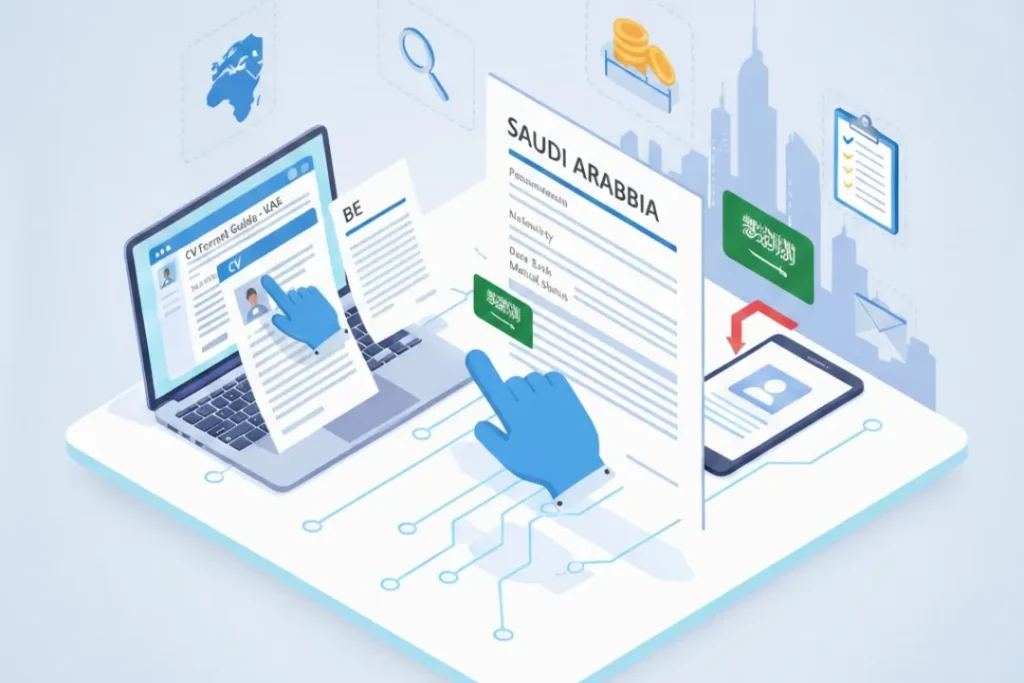
Saudi Arabia Resume Format

To develop a resume that will be relevant in the Saudi Arabia job market, one will have to be aware of the local business culture and expectations of the employers. A resume format in Saudi Arabia does not match that of the western standards in various aspects which are important and familiarizing yourself with these differences can greatly ensure that you get an interview. Being either a local job seeker or an international job applicant going to work in the Kingdom, then this extensive guide is sure to assist in writing an impressive CV that will make you stand out. Essential Components of a Saudi Resume Personal Information Section Resumes in Saudi Arabia contain more personal information as compared to Western CVs. Your resume must start with an extensive background of personal details such as your full name, date of birth, nationality, marital status and where you are at the moment. In contrast to most western nations where you are advised to leave your photograph out, Saudi employers tend to require one to provide a professional portrait on his or her resume. Stick a passport size photo in the upper right of the document. Contact details should be first visible and should have your mobile number, email address and the current address that you are staying in Saudi Arabia unless it is not relevant. In case you are an international applicant, state that you are willing to move and have a visa. Professional Summary Your professional summary will be a brief paragraph that will outline your most pertinent credentials and professional accomplishments. This section should be between three and five sentences and should bring out your experience, years of experience, and what you can bring with you to the prospective employers. Enter key words to your business and the job you are applying because most Saudi firms are applicant tracking systems. Educational Background In Saudi Arabia, education plays a very crucial role in the employment market. Include your educational qualifications in reverse chronological order including the latest degree. Add the name of the institution, degree received, major of study, date of graduation and honors or other awards. In case you graduated in international recognized universities, laying stress on this is significant as it holds weight when with Saudi employers. In cases where certain positions demand certain certifications or licenses, then have a separate section where you emphasize these requirements. Professional certifications particularly those that are internationally recognized can make you stand out among other people. Work Experience The work experience section is the centre of your Saudi Arabia resume format. Write down in reverse chronological order your history of employment including details of each position. Insert the name of the company, your work position, dates of employment, and place of employment. List under each position your responsibilities and your achievements with bullet points. The employers of Saudi like measurable results, thus use numbers, percentages, and definite results wherever feasible. As an example, rather than saying managed sales team, one can say led a team of 15 sales professionals with 125% of the annual targets. In case you have worked in the Middle East or with clients in the Middle East region, highlight this information because it shows the sensitivity to culture and the understanding of the local people. Skills Section Make a detailed skills section that comprises hard and soft skills that are pertinent to your target job. Those technical skills, language skills and software skills should be well enumerated. In Saudi Arabia, the Arabic language is greatly appreciated; therefore, in case you speak Arabic, display your level of proficiency in Arabic. Group skills into groups Technically skills, language skills and professional skills. This formatting offers an ease of accessibility whereby hiring managers can speedily point out your qualifications. Languages Since Saudi Arabia has a multiethnic workforce, the language skills are to be given particular consideration. Record all the languages that you speak and the level of proficiency (native, fluent, intermediate or basic). The most significant languages in the Saudi job market are Arabic and English, though any other language may be an advantage in competitive opportunities particularly in the multinational firms. Cultural Considerations for Saudi Resumes Length and Format Although western resumes focus on conciseness, Saudi employers do not mind longer, more comprehensive resumes. Two to three page resume is the norm and acceptable especially when it comes to the experienced professionals. Nevertheless, make sure that all of the information is valuable and applicable to your application. It should be in a professional format with plain fonts and spacing. The standard font such as Arial, Calibri, or Times New Roman, 11 or 12-point fonts are the best. Have a sufficient white space and clear section headings to enhance readability. References In contrast to Western habits when it is usual to specify in the resume that the references will be given when required, Saudi employers may want to have the references right before their eyes. Add two or three professional references giving their names, titles, businesses, and contact details. Make sure that you seek permission with your references. Tailoring Your Resume Make your resume unique to each job application and match your requirements to that of that job. Conduct research about the company and use the applicable keywords in the job description. The Saudi employers prefer candidates that show that they are interested in their organizations and in the positions they are applying. Common Mistakes to Avoid Do not apply generalized resumes which do not match the Kuwait market expectations. It is not necessary to add any information regarding the salary, and it is never acceptable to lie about qualifications or experience. Make sure that you are up to date with your contact information and that your email address is professional in sound. Grammar and spelling mistakes are instant disqualifier of your application and therefore make sure you proofread your application or have somebody look through your resume before handing it over. In case of applying to international companies

Scroll to Top